

Discover how electronic signatures streamline every stage of the employee lifecycle—from recruitment to final settlement—without paper or certified mail.
Imagine a new employee starts on Monday. You've already accepted the offer, but the contract is still on the way: you have to print it, sign it, send it, wait for it to come back, scan it and file it. Meanwhile, the clock is ticking.
If you work in HR, it surely sounds familiar to you. And it is not a minor detail: your department plays a fundamental role within any organization. It manages one of the most important assets of a company: its people.
Candidate selection, hiring, employment documentation, contractual modifications, internal communications, terminations... Throughout the employment relationship, numerous documents are generated that must be sent, reviewed, approved, signed and, subsequently, archived.
Paper costs you more than it seems
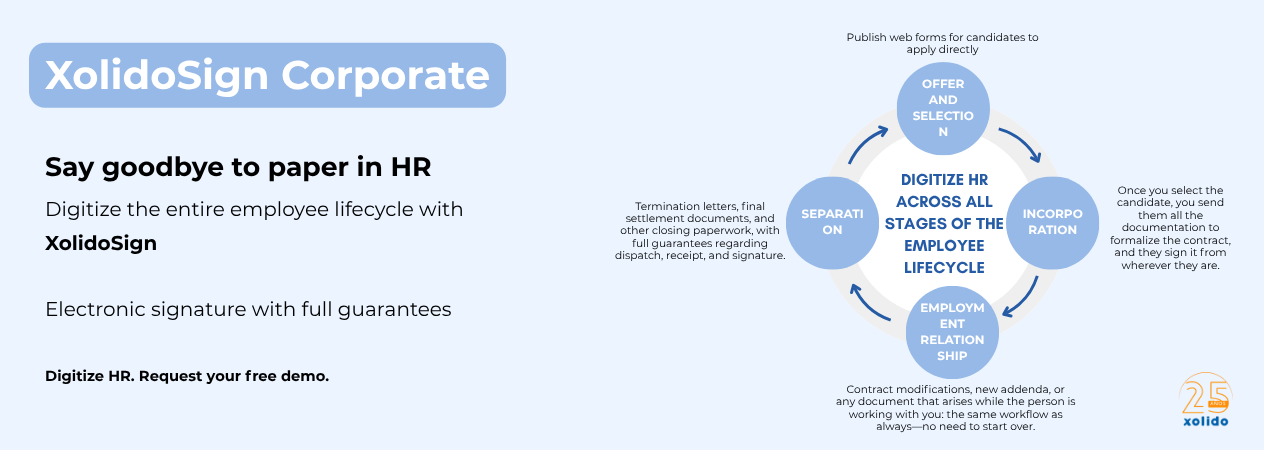
Every employee goes through four stages: offer and selection, onboarding, the employment relationship, and offboarding. Documents are generated at every stage, and if they are handled using paper, the same problems arise:
- Onboarding delays while waiting for a signature.
- Mountains of paper, printouts, and filing cabinets.
- Mailing and courier costs.
- Protracted processes that—no matter how hard you try—cannot be shortened.
None of these costs is staggering on its own, but when added up over the course of a year (and across hundreds of documents), they become a significant burden.
Why perform multiple manual steps when they can be integrated into a single digital flow?
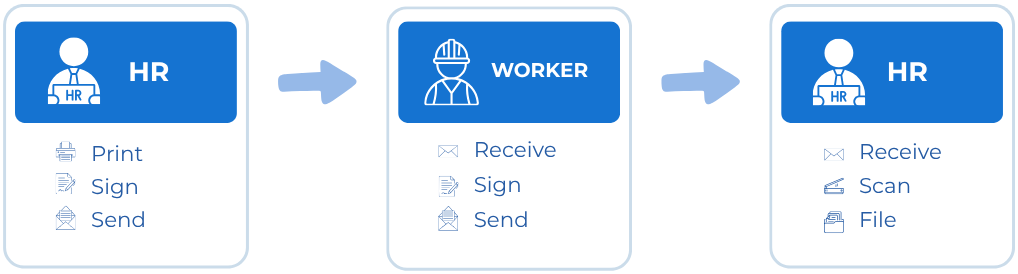
With paper, signing a document involves chaining together several manual steps, each depending on whether someone has time, is in the office, or has picked up the mail.
With electronic signatures, everything happens in a single workflow. You upload the document, define what is needed (a signature, a notification, or an approval) and who needs to be involved—whether it’s two, three, or as many people as necessary. From there, the process runs automatically: each person takes their turn at the right moment, without you having to chase anyone down.
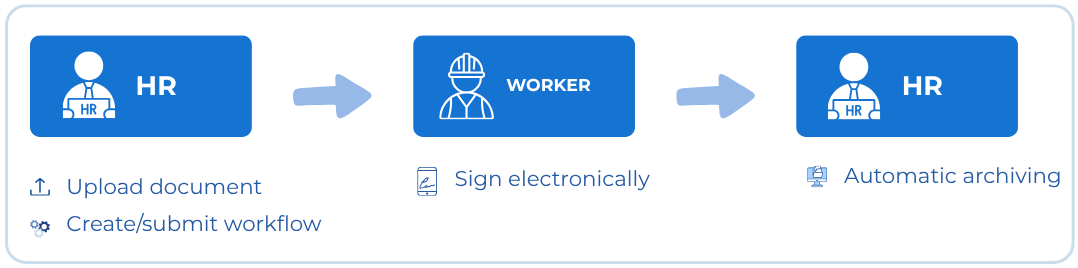
And, once completed, the documentation remains available alongside the electronic evidence generated during the processing.
And is it legally valid?
It is the question that HR asks most before taking the step, and with good reason: we talk about contracts, modifications and even dismissals.
The electronic signature is recognized in the European Union through the eIDAS regulation, and the important thing in practice is to be able to demonstrate who signed, when and what they signed. That is why each step of the process must be recorded with electronic evidence.
Four stages, zero paper
With XolidoSign, you can digitize the entire employee lifecycle:
- Offer and selection. Publish web forms so candidates can submit their applications directly.
- Onboarding. Once you select a candidate, send them all the documentation to formalize the contract and sign it from anywhere. They start on Monday with everything ready to go.
- Employment relationship. Contract amendments, new addendums, or any document that arises while the person is working with you—using the same workflow without having to start over.
- Offboarding. Termination letters, final settlement documents, and other closing paperwork, with full guarantees regarding delivery, receipt, and signature.
And at every stage, every step and every person involved is logged. Exactly what you need should a legal dispute ever arise.
Do you want to digitize your company's HR processes?
Digitizing HR isn't about technology for technology's sake; it’s about saving time, reducing costs, and focusing on what truly matters: people.
Would you like to see it in action? Tell us about your use case and request a free demo of XolidoSign Corporate.
| Request your free demo |
When a company wants to digitize its processes, it’s looking for much more than just implementing a tool: it seeks to automate processes, connect applications, reduce manual tasks, and simplify day-to-day management.
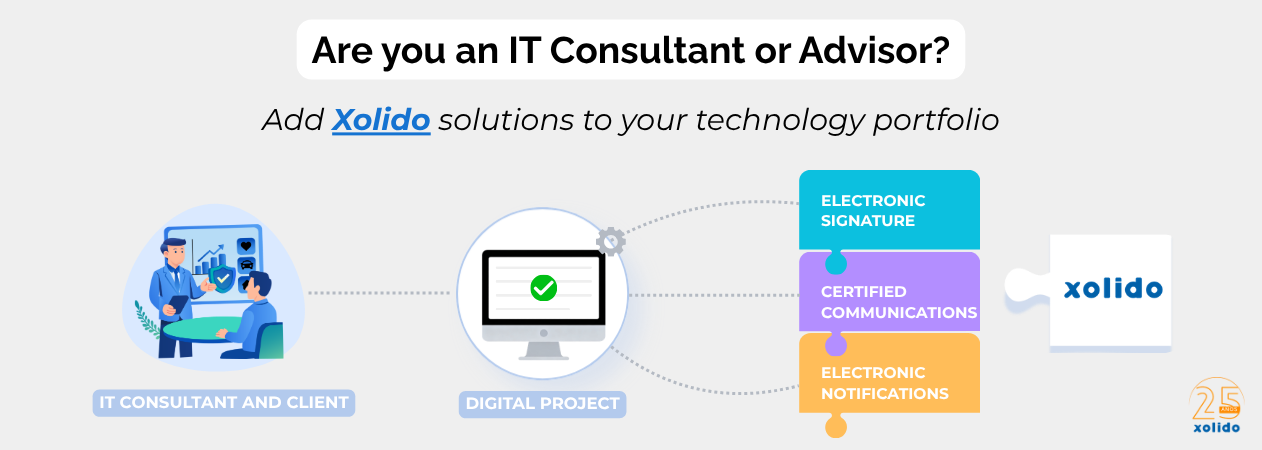
And in many of those processes, there are likely to be needs related to electronic signatures, certified communications, or electronic notifications.
At Xolido, we have been developing solutions in this field for more than 25 years, and the addition of these products would boost the productivity and competitiveness of any business.
Because digital transformation doesn’t end with ERP or CRM
A digital transformation project may begin with the implementation of an ERP, a CRM, a document management solution, or an HR platform.
But sooner or later, many of these processes require additional action:
signing, communicating, or notifying.
What Benefits Do Xolido Solutions Offer?
- Complete projects using specialized technology for electronic signatures and communications.
- Expand services for your current clients without having to develop your own solution.
- Identify new business opportunities within your portfolio.
- Integrate our solutions into technology projects you’re already developing.
- Rely on Xolido’s support for specialized aspects of digital signatures, evidence, and electronic communications.
Which Xolido solutions can be integrated into your consulting firm’s technology projects
- Electronic signature: from simple processes to more advanced signature workflows.
The signature can be part of a company’s internal processes or integrated directly into applications and platforms used by its clients. - Certified electronic communications: When a company needs to send a communication and retain electronic evidence of the process, a certified communication can provide an additional layer of security and traceability.
- Electronic administrative notifications: Government agencies and certain entities, such as professional associations or organizations subject to administrative procedures, have specific needs related to the management of electronic notifications.
API Integration
Xolido’s solutions can be integrated into existing applications and systems via Web Services APIs, allowing electronic signatures or communication to become part of the workflow itself.
Xolido: Technology to Help You Complete Your Projects
Our goal is to collaborate with consulting firms, integrators, developers, and IT service providers who want to expand their offerings and provide new solutions to their clients.
The consulting firm understands the client, its processes, and its needs
Xolido provides the technology and specialized expertise in digital signatures and certified electronic communications
Summer, a Peak Time for Human Resources
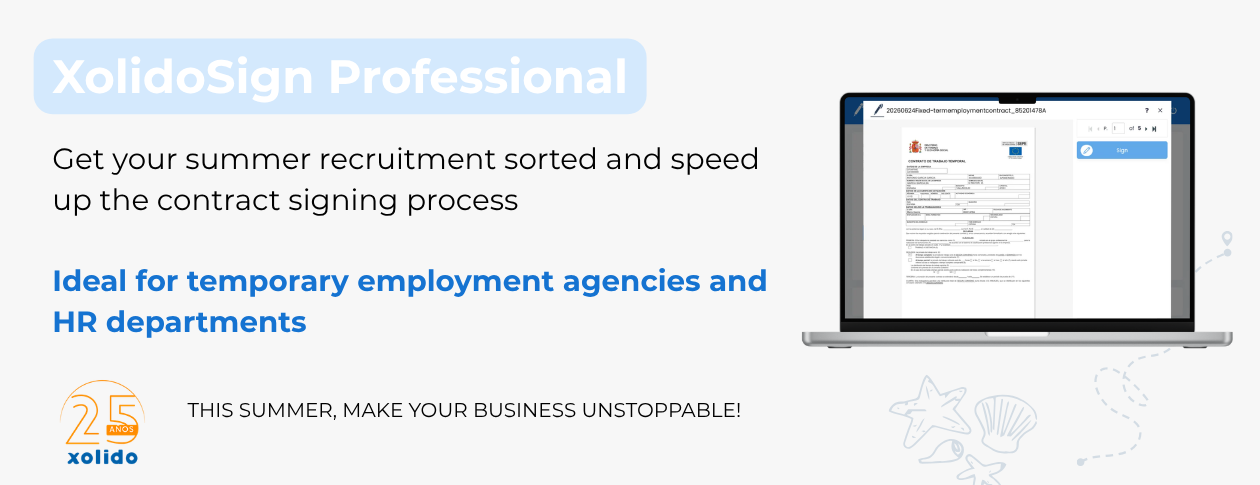
The arrival of summer brings a significant increase in hiring across many sectors. Tourism, hospitality, retail, logistics, manufacturing, and services all turn to temporary workers to meet the surge in demand, which means managing a large volume of contracts in a short period of time.
The 2026 summer season is expected to generate between 790,000 and more than 1.2 million contracts in Spain (a 12% year-over-year increase).
For Human Resources departments, labor consulting firms, and temporary staffing agencies (ETT), this scenario poses a major challenge: formalizing contracts quickly, securely, and efficiently, while avoiding delays that could affect the onboarding of new employees.
Electronic signatures are the perfect solution for streamlining the contracting process
Electronic signatures make it possible to formalize employment contracts entirely online, while maintaining the necessary legal safeguards and streamlining the entire process.
Thanks to this technology, companies can send contracts to employees for them to sign from anywhere using any device with Internet access.
The result is a faster, more convenient, and more efficient process for both the organization and the employee.
How XolidoSign Professional Transforms Your HR Management This Summer
XolidoSign Professional facilitates the electronic signing of employment contracts by streamlining hiring processes and eliminating physical barriers.
- Sign from any device
With XolidoSign, candidates don’t need to download any apps—they simply receive a notification, access the document, and sign intuitively from their smartphone, tablet, or computer, no matter where they are. - Multi-signature and automated workflows
XolidoSign Professional allows you to configure cascading or parallel signing workflows. The platform automatically forwards the document to the next signer as soon as the previous one has signed. - Full traceability and status tracking
You can monitor the status of each document in real time: sent, delivered, read, or signed. You’ll know exactly who still needs to sign and can send reminders with a single click. - Full legal validity and legal certainty (eIDAS)
XolidoSign Professional ensures compliance with regulations, including the European eIDAS Regulation. Each process generates an electronic evidence document that reflects the entire process of sending and electronic signing.
Particularly useful for staffing agencies, companies with high employee turnover, and HR departments
Temporary staffing agencies and organizations that handle large volumes of hiring find electronic signatures to be a particularly valuable tool.
When dozens or hundreds of contracts need to be finalized in a short period of time, having a digital system in place improves the HR team’s productivity and provides a better experience for employees.
This summer, make your business unstoppable
Digitizing hiring processes is a must for organizations seeking to become more agile and competitive.
With XolidoSign Professional, companies, consulting firms, and staffing agencies can streamline the signing of employment contracts and focus on what really matters: bringing in talent and meeting their business needs.
With the full implementation of Organic Law 1/2025 on the Efficiency of Justice, real estate agencies and owners can no longer go directly to court in cases of non-payment of rent, claims for damages to the property, return of the deposit, breach of contractual obligations or disagreements about repairs and maintenance.
The law requires attempting an ADR (Appropriate Means of Dispute Resolution) as a mandatory prerequisite to any civil lawsuit.
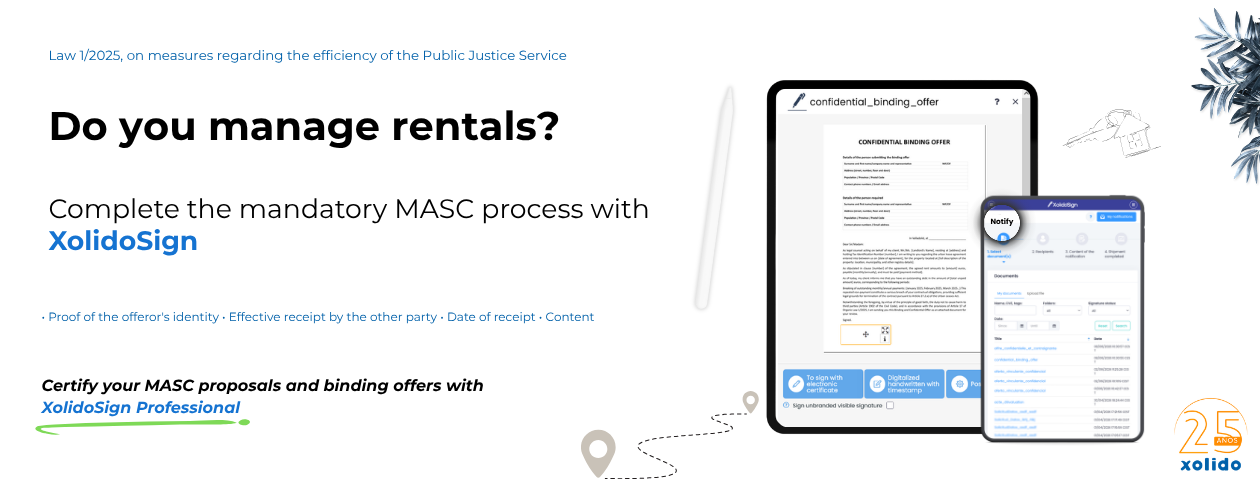
How can this procedure be completed quickly, cheaply, and with full legal guarantees before a judge?
The answer lies in certified electronic communication and digital signatures, an area where XolidoSign Professionalis establishing itself as the indispensable strategic ally.
1. Certified Electronic Communication with Absolute Traceability
When a real estate agency sends a MASC agreement proposal or a Binding Offer through our platform, it's not just sending a regular email. XolidoSign automatically generates an Evidence Report with complete traceability of the communication.
- Identification and Logs: Records email addresses, source and destination IPs, and delivery logs on the tenant's server.
- Content Integrity: Ensures, through hashing algorithms, that the text of the request and attached documents have not been tampered with, serving as documentary evidence.
2. Closing the agreement using Biometric Signature or Certificate
If the ADR process is successful and the tenant accepts the proposal (a payment plan, a mutually agreed-upon return of keys, etc.), the conflict should be resolved with full guarantees.
XolidoSign Professionalallows you to formalize the agreement immediately using different types of digital signatures. For tenants without a digital certificate, biometric handwriting from any smartphone or tablet captures the signer's handwriting data (pressure, speed, stroke), giving the document legal validity as a signature with legal standing.
3. Efficiency and cost control for real estate
Unlike cumbersome postal processes, XolidoSign Professional stands out for its versatility:
- It's a cloud-based solution, requiring no complex installations.
- It allows for complete cost control, eliminating fees for registered mail or other individual delivery charges.
- It optimizes agency time: what used to take days to process by post can now be managed and certified in minutes.
A smart workflow in the face of conflict
Thanks to XolidoSign, a real estate agency's protocol for handling situations such as rent defaults is automated and simplified:
- Issuance: The agency drafts the Confidential Binding Offer (BBA) and sends it electronically via XolidoSign.
- Certification: XolidoSign acts as a neutral Trusted Third Party, issuing a certificate that proves the tenant has received the offer.
- Resolution:
- If there is an agreement: The parties digitally sign the transactional document on the platform, making it legally binding.
- If there is no agreement: The XolidoSign Evidence Report is attached to the legal claim to demonstrate to the judge that the procedural requirements of Organic Law 1/2025 were met.
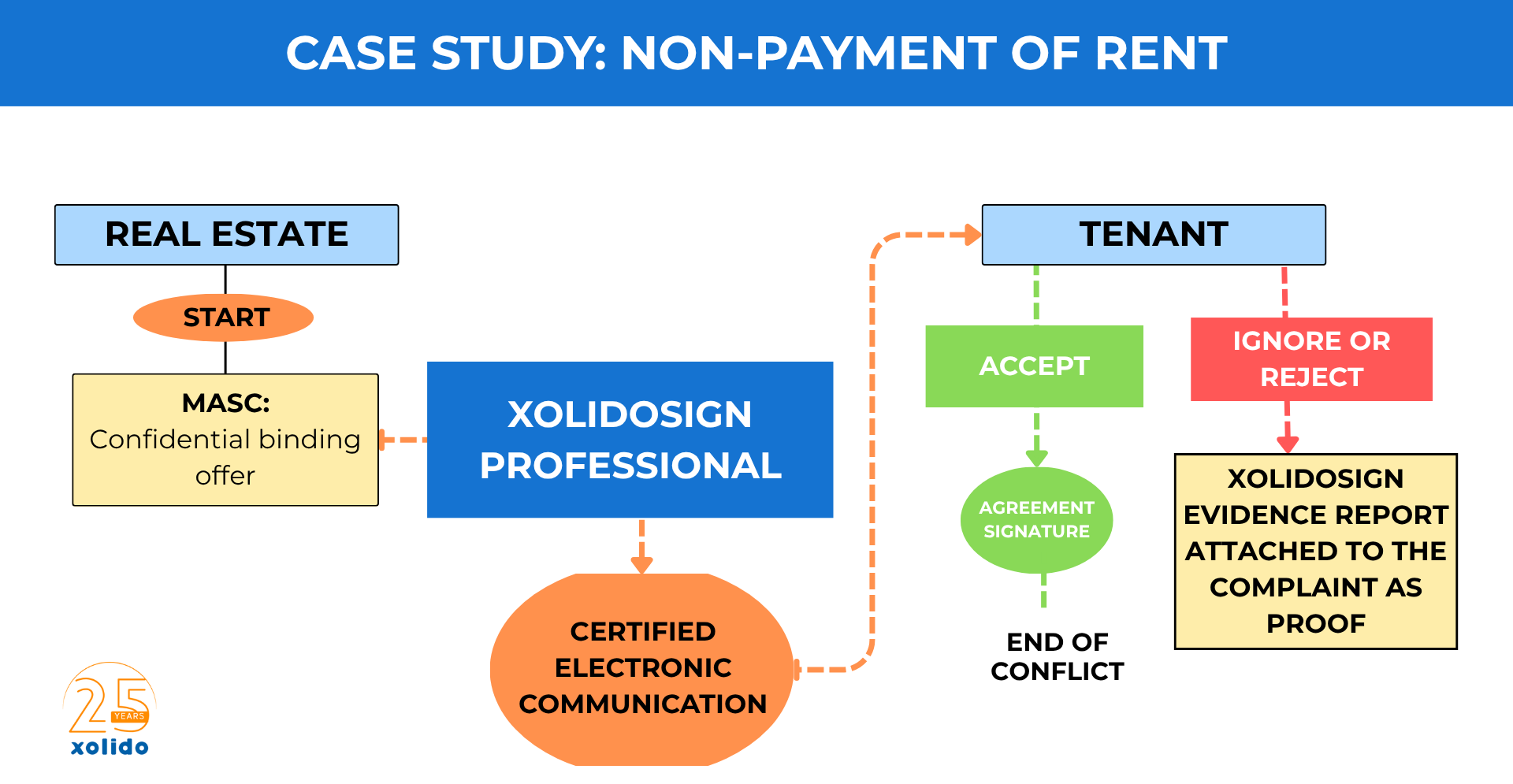
UsingXolidoSign Professional not only guarantees strict compliance with MASC regulations, but also provides a distinct added value to its owner clients.
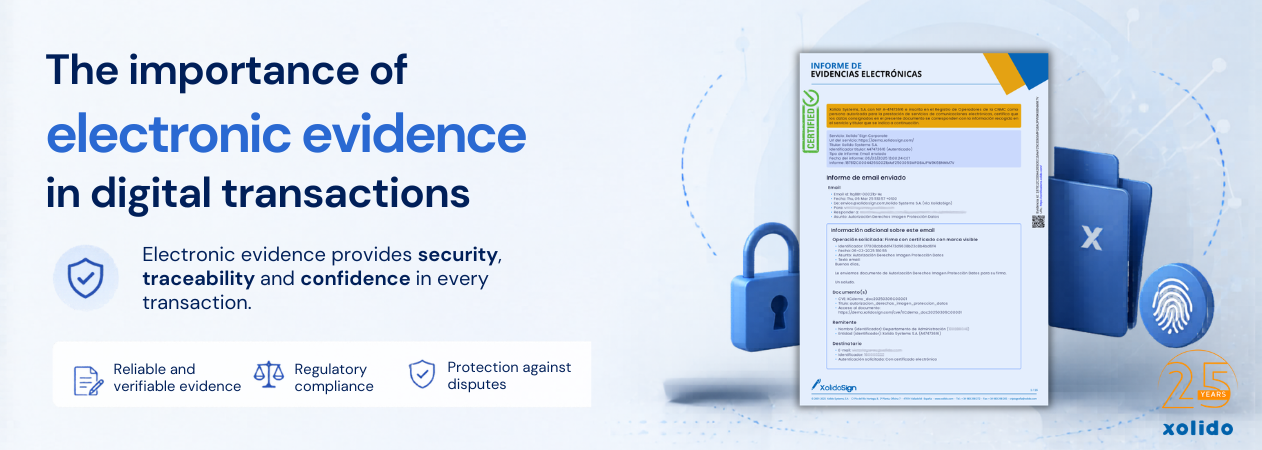
Digital transformation has changed the way companies and organizations formalize agreements, report information, and manage their internal processes. Electronically signed contracts, online acceptance of terms and conditions, certified communications, and digital authorizations are now part of everyday business operations.
However, in this new digital environment, a fundamental question arises: how can we subsequently prove that a specific action actually took place?
This is where electronic evidence comes into play—the unsung hero of digital transformation.
What is electronic evidence?
Electronic evidence is a set of structured data (metadata, network logs, signatures, and timestamps) that allows a digital event to be reconstructed with absolute certainty.
What is truly important is being able to reliably verify aspects such as:
- Authenticity: who performed the action.
- Integrity: whether the information has remained intact since the operation was performed and on exactly what content the action was performed.
- Non-repudiation: The impossibility of one of the parties saying, “It wasn’t me.”
The Importance of Traceability
Every digital interaction leaves a technical trail that, when properly managed and preserved, provides confidence and serves as evidentiary support.
Traceability thus becomes an essential element when it can be demonstrated:
- what was sent,
- what was received,
- that the content has not been altered,
- and that the identity of the parties involved can be verified.
Electronic signatures and evidence: two inseparable concepts
The electronic signature is one of the clearest examples of the importance of electronic evidence.
Signing a document digitally is not merely a matter of adding a signature or clicking an acceptance button. Behind this process lie various technological mechanisms that ensure:
- the identity of the signer,
- the integrity of the document,
- the date and time of the transaction,
- and the impossibility of modifying the content without leaving a trace.
The evidence associated with the signature is what provides true legal and evidentiary value to the transaction. However, it is important to note that the evidentiary value will vary depending on the type of signature used.
Certified Electronic Notifications
Another area where electronic evidence is essential is that of electronic notifications.
When a company needs to communicate important information—such as contractual notices, claims, renewals, or legal communications—it must not only send the message but also be able to prove that the message was successfully delivered.
Electronic evidence allows for the verification of essential aspects such as:
- the exact content communicated,
- the date and time of sending,
- delivery to the recipient,
- access to or reading of the notification,
- and the integrity of the entire communication.
This makes certified electronic notifications a particularly useful tool for providing legal certainty and reducing risks.
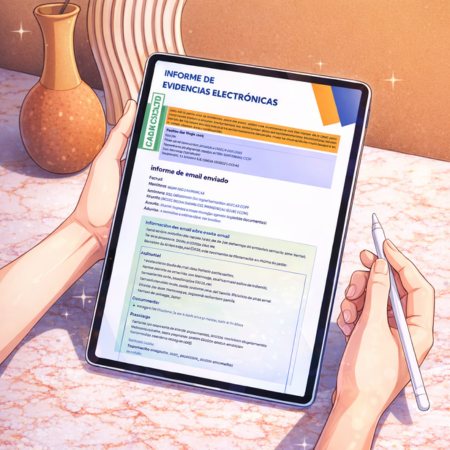 The Xolido Electronic Evidence Report.
For every digital transaction you perform on Xolido, a detailed Electronic Evidence Report can be generated.
Providing security and value to your digital procedures.
- Unique process identifiers.
- Integrity: Hash algorithms for the document and signature.
- Event log: sending, receiving, signing...
- Timestamp
- IP traceability
Conclusion: Security Equals Profitability
Digitizing processes isn’t just about eliminating paper. It’s about creating an environment where every transaction leaves a solid, legally binding trail. Investing in high-quality electronic evidence isn’t an expense; it’s your company’s best defense.
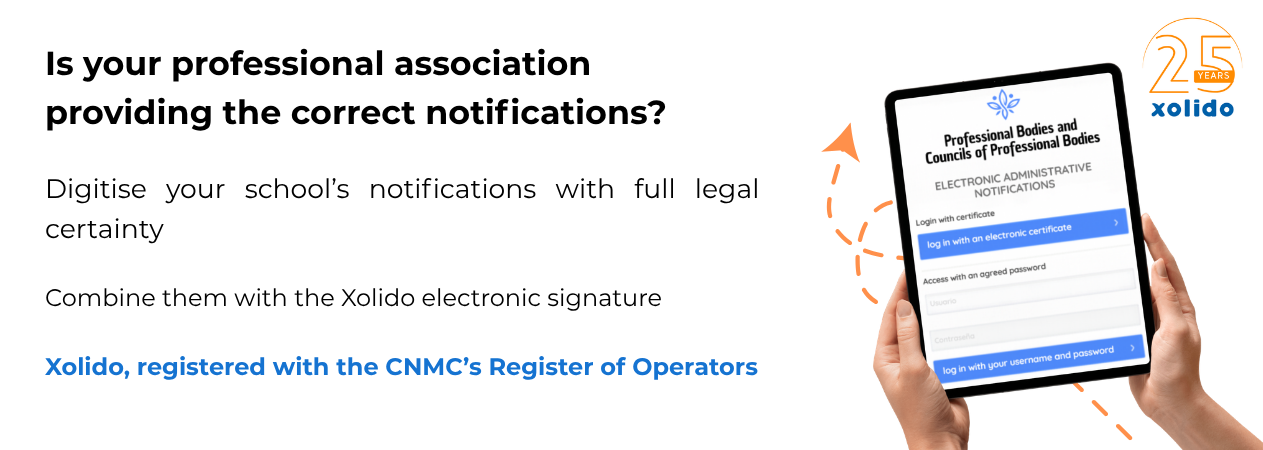
Professional bodies are required to use electronic notifications in their administrative procedures in various situations, as set out in Law 39/2015 of 1 October on the Common Administrative Procedure of Public Administrations.
In this context, many professional bodies are asking themselves: is it mandatory to notify members electronically?
The answer is clear: yes, in most cases. .
Who is required to do so?
Under Article 14.2, the following must communicate with the Administration electronically:
- Legal entities
- Entities without legal personality
- Professionals subject to compulsory registration with a professional body (solicitors, architects, engineers, etc.)
How does this affect professional bodies?
Very directly.
Professional bodies must notify their members electronically of all administrative procedures that concern them, particularly those involving sanctions or decisions affecting members’ rights.
Ensuring that the referee receives them correctly.
How does this work in practice?
In its day-to-day operations, a professional association must use electronic means to:
- Submit decisions
- Communicate agreements and notices
- Notify disciplinary sanctions
- Handle any administrative procedures
All of this ensures that the member actually receives the communication.
The solution: digitising your notifications properly
This is where specific tools such as the following come into play:
Xolido Notify
For electronic administrative notifications
- It meets the legal notification requirements, complying with the provisions of Law 39/2015 without any complications.
- It ensures evidence and traceability.
- Integrate it with your own or third-party applications.
XolidoSign Professional
For certified electronic communications
- Ideal for communications that are not strictly administrative.
- Enables the sending of messages with evidential value
- Ensures integrity and delivery.
Benefits of Electronic Notification
The shift from paper to electronic filing is not merely a bureaucratic burden; it offers tangible benefits for both parties:
- Efficiency and Speed: A significant reduction in delivery and receipt times.
- Legal certainty: There is an accurate record of the date and time when the content was made available and accessed (or when the notification was rejected).
- Sustainability: A reduction in paper usage and postal delivery costs.
In summary
It’s not just about sending emails.
It’s about ensuring your communications comply with legal requirements and managing your relationship with your members effectively.
If you have any questions about how to implement these systems correctly, please get in touch and we’ll go through it with you.
| soporte@xolidosign.com |

Xolido products
IT infrastructure and cloud services
About us