

May 2026 Newsletter - The Importance of Electronic Evidence in Digital Transactions
Digital transformation has changed the way companies and organizations formalize agreements, report information, and manage their internal processes. Electronically signed contracts, online acceptance of terms and conditions, certified communications, and digital authorizations are now part of everyday business operations.
However, in this new digital environment, a fundamental question arises: how can we subsequently prove that a specific action actually took place?
This is where electronic evidence comes into play—the unsung hero of digital transformation.
What is electronic evidence?
Electronic evidence is a set of structured data (metadata, network logs, signatures, and timestamps) that allows a digital event to be reconstructed with absolute certainty.
What is truly important is being able to reliably verify aspects such as:
- Authenticity: who performed the action.
- Integrity: whether the information has remained intact since the operation was performed and on exactly what content the action was performed.
- Non-repudiation: The impossibility of one of the parties saying, “It wasn’t me.”
The Importance of Traceability
Every digital interaction leaves a technical trail that, when properly managed and preserved, provides confidence and serves as evidentiary support.
Traceability thus becomes an essential element when it can be demonstrated:
- what was sent,
- what was received,
- that the content has not been altered,
- and that the identity of the parties involved can be verified.
Electronic signatures and evidence: two inseparable concepts
The electronic signature is one of the clearest examples of the importance of electronic evidence.
Signing a document digitally is not merely a matter of adding a signature or clicking an acceptance button. Behind this process lie various technological mechanisms that ensure:
- the identity of the signer,
- the integrity of the document,
- the date and time of the transaction,
- and the impossibility of modifying the content without leaving a trace.
The evidence associated with the signature is what provides true legal and evidentiary value to the transaction. However, it is important to note that the evidentiary value will vary depending on the type of signature used.
Certified Electronic Notifications
Another area where electronic evidence is essential is that of electronic notifications.
When a company needs to communicate important information—such as contractual notices, claims, renewals, or legal communications—it must not only send the message but also be able to prove that the message was successfully delivered.
Electronic evidence allows for the verification of essential aspects such as:
- the exact content communicated,
- the date and time of sending,
- delivery to the recipient,
- access to or reading of the notification,
- and the integrity of the entire communication.
This makes certified electronic notifications a particularly useful tool for providing legal certainty and reducing risks.
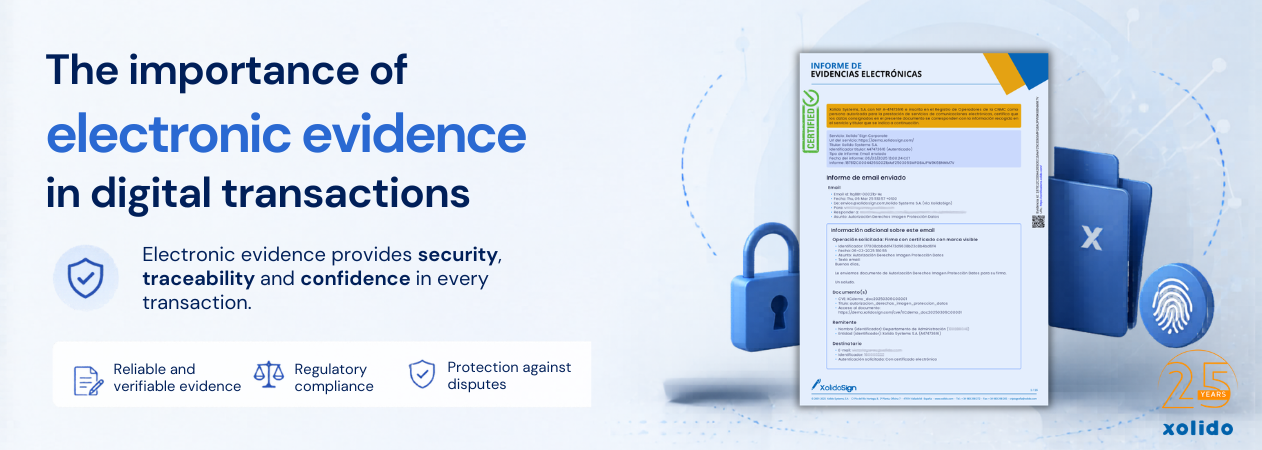
 The Xolido Electronic Evidence Report.
For every digital transaction you perform on Xolido, a detailed Electronic Evidence Report can be generated.
Providing security and value to your digital procedures.
- Unique process identifiers.
- Integrity: Hash algorithms for the document and signature.
- Event log: sending, receiving, signing...
- Timestamp
- IP traceability
Conclusion: Security Equals Profitability
Digitizing processes isn’t just about eliminating paper. It’s about creating an environment where every transaction leaves a solid, legally binding trail. Investing in high-quality electronic evidence isn’t an expense; it’s your company’s best defense.


Xolido products
IT infrastructure and cloud services
About us